A Finite Observable Universe
A lot of what we do in the lab comes down to turning something real - a slice of tissue, a population of neurons, a pattern of activity - into a grid of numbers: a microscopy image. Every image we ever collect is, underneath the biology, just a matrix: a fixed number of positions, each holding one of a fixed number of possible values.
That framing leads to an interesting notion. If an image is just a matrix, then the set of every image that could ever exist at a given resolution and bit depth isn't open-ended but an exact, countable (but enormous) number. Every photograph, every scan, every view of every galaxy, every possible frame of every possible microscope, at that resolution, is somewhere in that set. Below, this page generates one such image every second: a random 48×48, 4-bit (16 gray level) grayscale pattern, plucked from a space so large that generating even a tiny fraction of it, exhaustively, is not something the universe has had time to do.
Almost none of that space looks like anything. A pattern earns the word “image” (a face, a galaxy, a slice of tissue, even just a smooth gradient or a simple shape) because it has structure, that is, neighboring pixels relate to each other, there's redundancy. This “sensible” universe - the photographs, the microscope fields, the recognizable anything - isn't merely a small part of this space. It's a razor-thin, structured sliver in an ocean of static. The image below will almost always land in the ocean, but every second there is a potential for generating an image that represents something real in the universe and you may be here to witness it for the first time. If you're seeing such an image, don't hesitate and hit the save button. You may be the only one who will ever see it, and saving it is the only thing standing between that moment and it disappearing back into the noise for good.
Eight originals scaled down to 48×48 pixels, grayscale, quantized to 16 levels.
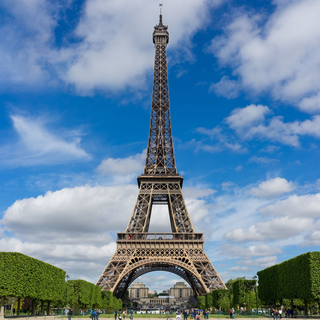


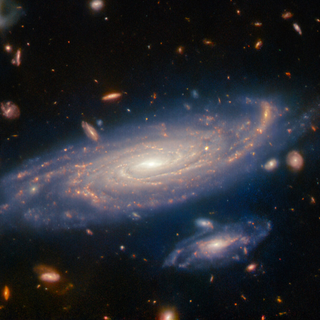
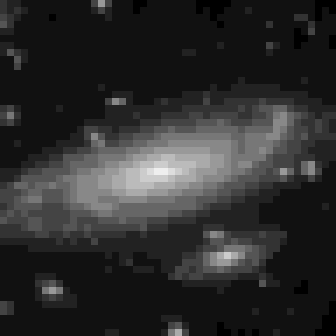
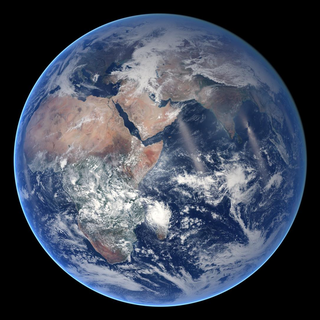
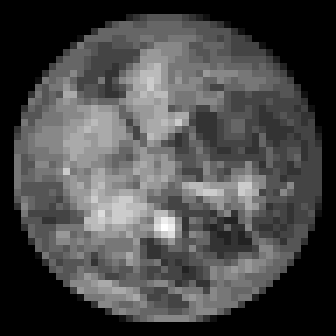
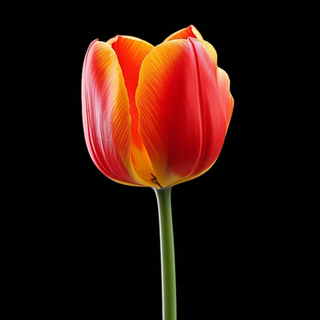


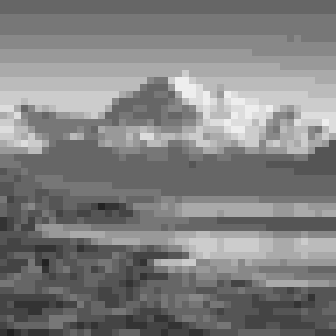
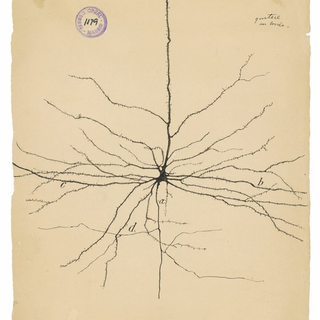
All eight are real: seven photographs, plus a real drawing of a neuron by Santiago Ramón y Cajal. All start from the same 512×512 square before being reduced.
And 48×48/4-bit is still the toy case. A single 4K, 10-bit HDR video frame's possible-image count runs to roughly 75 million digits to describe a single image (~27,000× longer, assuming no compression). And of course, biology goes even further: the human eye's dynamic range exceeds 30 stops (from starlight to daylight), and some species add whole channels we don't have, including ultraviolet in birds and insects, infrared sensing in pit vipers, and up to 12 photoreceptor types in mantis shrimp.
None of these are curated or selected. Every image is pulled from the space at random. That cuts both ways: given long enough (exceeding many lifetimes of our universe), this same process would eventually produce anything expressible in 48×48, 4-bit. The beautiful, the mundane, the disturbing. The good, the bad, the ugly. This is indistinguishable to the generator itself. It has no taste. It only has the space, and some time.